



Lifting Big Trees Out Instead of Dropping Them
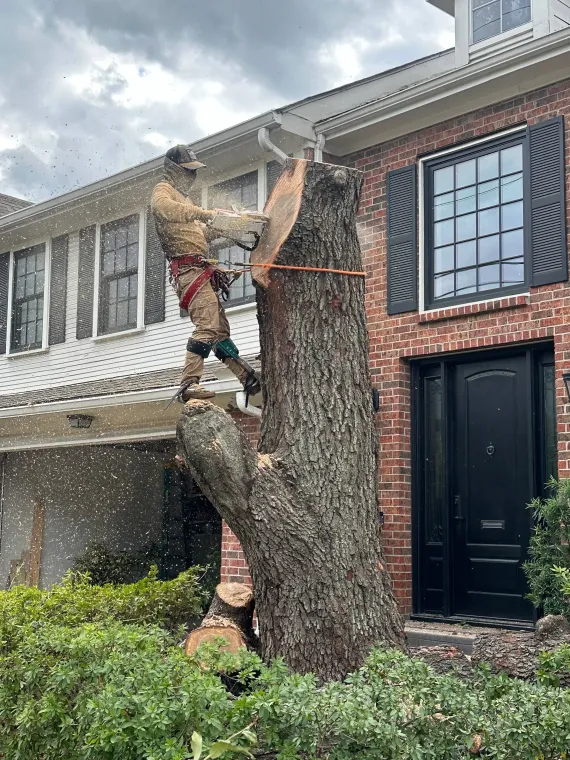
Some trees cannot be climbed safely. A dead pine with compromised wood will not hold a climber. A massive oak over a pool, a sunroom, or a neighbor’s roof leaves no drop zone at all. In those situations a crane is not a luxury — it is the only method that gets the tree out without risking someone’s life or the structure underneath.
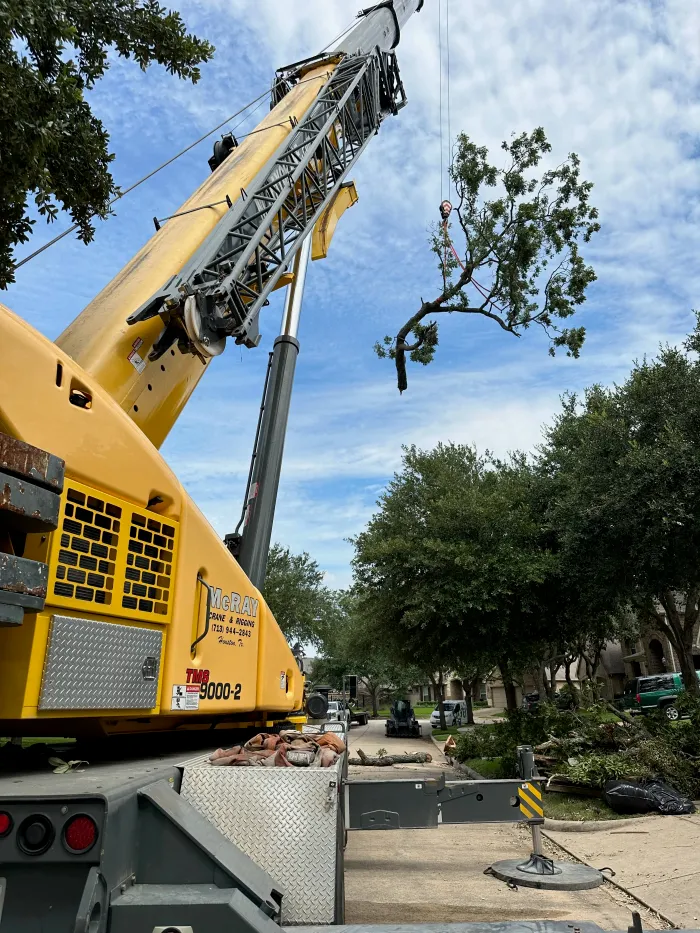
With a crane, sections are cut, picked, and flown clear rather than dropped or lowered through the canopy. Nothing swings, nothing bounces, and the load never passes over what you are trying to protect. It is also dramatically faster: crane removals that would take a climbing crew two or three days often finish in one.
When a Crane Is the Right Call
- Very Large or Tall Trees: Mature pines, oaks, and pecans carry more weight in a single limb than most people estimate, and a crane takes that weight deliberately rather than dynamically.
- Dead or Decayed Trees: Compromised wood cannot be trusted to hold a climber. If the tree is unsafe to climb, it is a crane job by definition.
- Trees Over Structures: Pools, patios, sunrooms, and neighboring roofs leave no margin. A crane keeps every section from ever passing over what you are protecting.
- No Drop Zone or Access: Backyards hemmed in by fencing and structures often cannot fit equipment at all. A crane reaches in from the street instead.
- Trees Resting on a Roof: Cutting a tree apart while it sits on your house shifts load unpredictably. A crane takes the weight first, then the cuts are made.
Why Choose Us for Crane Removals?
- Engineered Pick Plans: Every job starts with a site assessment: setup space, overhead clearance, underground utilities, and calculated pick weights before a single cut is made.
- Often Cheaper Overall: A crane can finish in hours what takes a climbing crew days. On the right tree, the total labor saving more than covers the machine.
- Protected Setup: Outrigger pads spread the load, and we use plywood or matting over driveways and soft ground. We walk the setup plan with you beforehand.
- Permits Coordinated: If the crane has to set up in the street, we handle the permit and lane-closure coordination and tell you up front what it adds to the timeline.

Tree Crane Services Questions
Is crane removal more expensive?
Per day, yes — a crane and operator cost more than a climbing crew. Per job, often not. A crane can finish in hours what would take a climbing crew several days, and on trees over structures it sharply reduces the risk of property damage. On the right tree it is frequently the cheaper option once you total the labor.
How much room does the crane need?
Less than most people assume. We need a stable setup area for the outriggers, typically a street, driveway, or firm open ground, and a clear overhead path for the boom. Modern cranes have substantial reach, so the setup point is often well away from the tree itself. We confirm all of this during the site visit.
Will the crane damage my driveway or lawn?
We plan for this. Outrigger pads spread the load across a much wider footprint, and we use plywood or matting over driveways and soft ground. Damage is uncommon, and we walk the setup plan with you before the crane arrives so there are no surprises.
Do you handle the permits and street closure?
If the crane has to set up in the street, that can require a permit or a temporary lane closure depending on the location. We handle the coordination and will tell you up front whether your job needs it and what it adds to the timeline.
Can a crane lift a tree off my house?
Yes, and this is one of the best uses for one. Rather than cutting a tree apart while it rests on your roof, which shifts load unpredictably and can do more damage, the crane takes the weight first, then sections are cut and flown clear. It is the least destructive way to get a tree off a structure.
Get A Free Estimate For Tree Services Today!
Schedule An Estimate
 (832) 596-5133
 Click To Email Us
 Houston, TX